
CATALYST
DENVER MUSEUM OF NATURE & SCIENCE ONLINE MAGAZINE
When Triceratops Dreams Come True
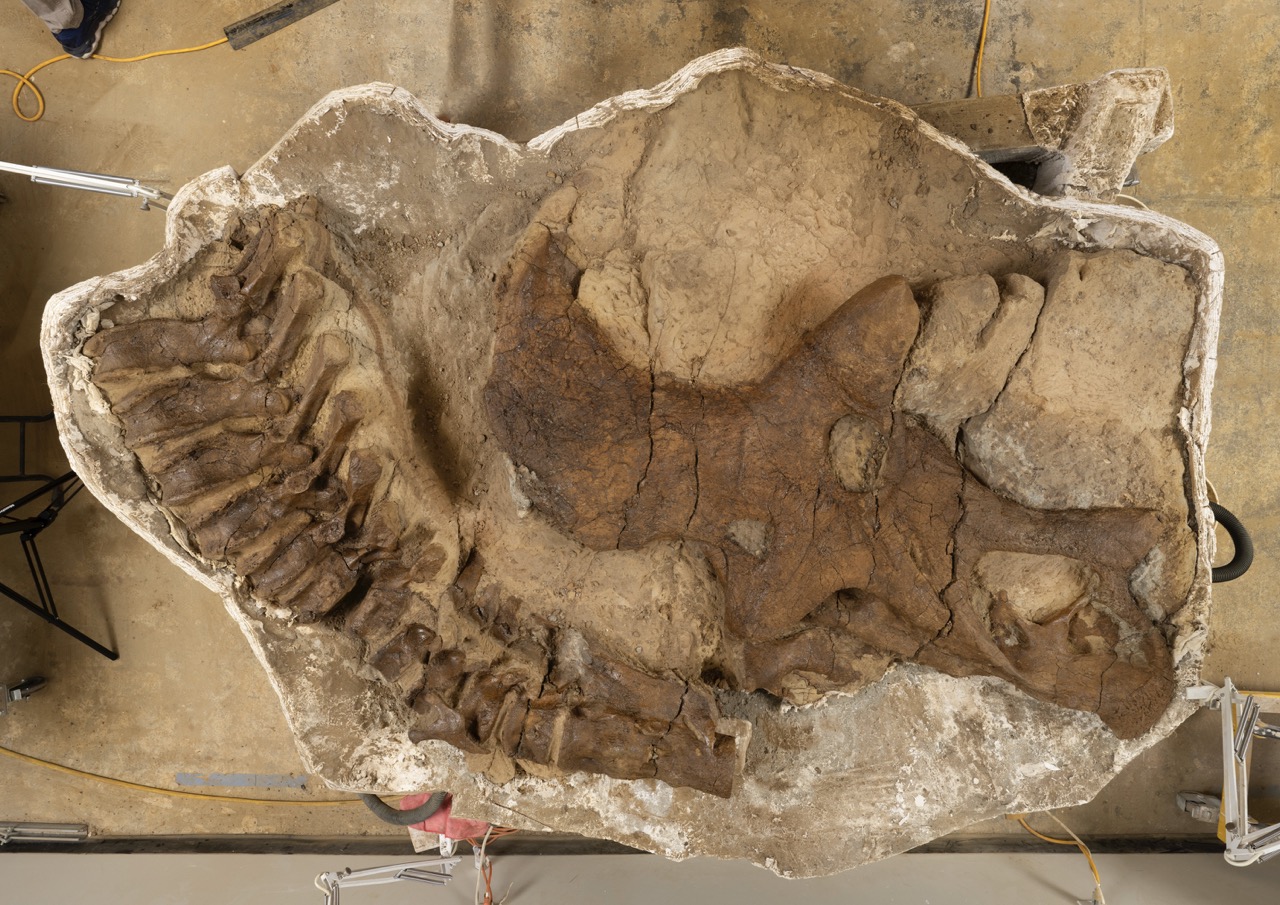
Overhead view of Triceratops jacket, Denver Museum of Nature & Science (Photo: Rick Wicker)
Every July, a team of staff, interns and volunteers from the Department of Earth Sciences descend on Marmarth, North Dakota in search of new discoveries waiting in the Hell Creek badlands. Home to iconic dinosaurs such as Tyrannosaurus rex and Triceratops, the Hell Creek Formation is an expansive rock unit found across Montana and the Dakotas that dates to 66-68 million years old. It preserves North America’s last dinosaur ecosystem before a six-mile wide asteroid struck Earth and wiped out 75% of life, including all non-avian dinosaurs.
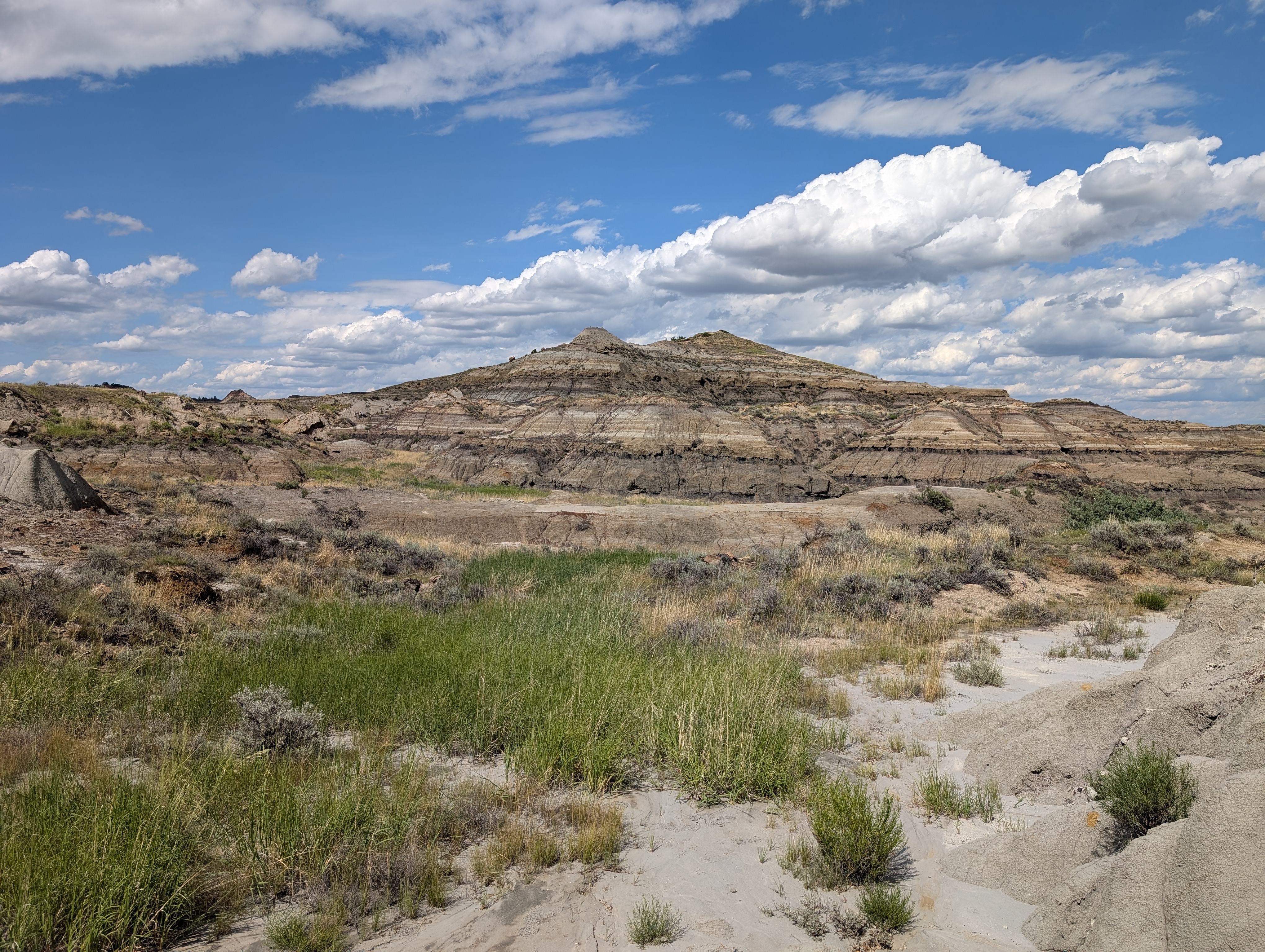
Panoramic of the Hell Creek Formation, Marmarth, North Dakota (Photo: Evan Tamez-Galvan)
In the summer of 2023, our team excavated and collected Teen Rex, a magnificent juvenile Tyrannosaurus rex discovered by Liam and Jessin Fisher, their father Sam Fisher and cousin Kaiden Madsen.
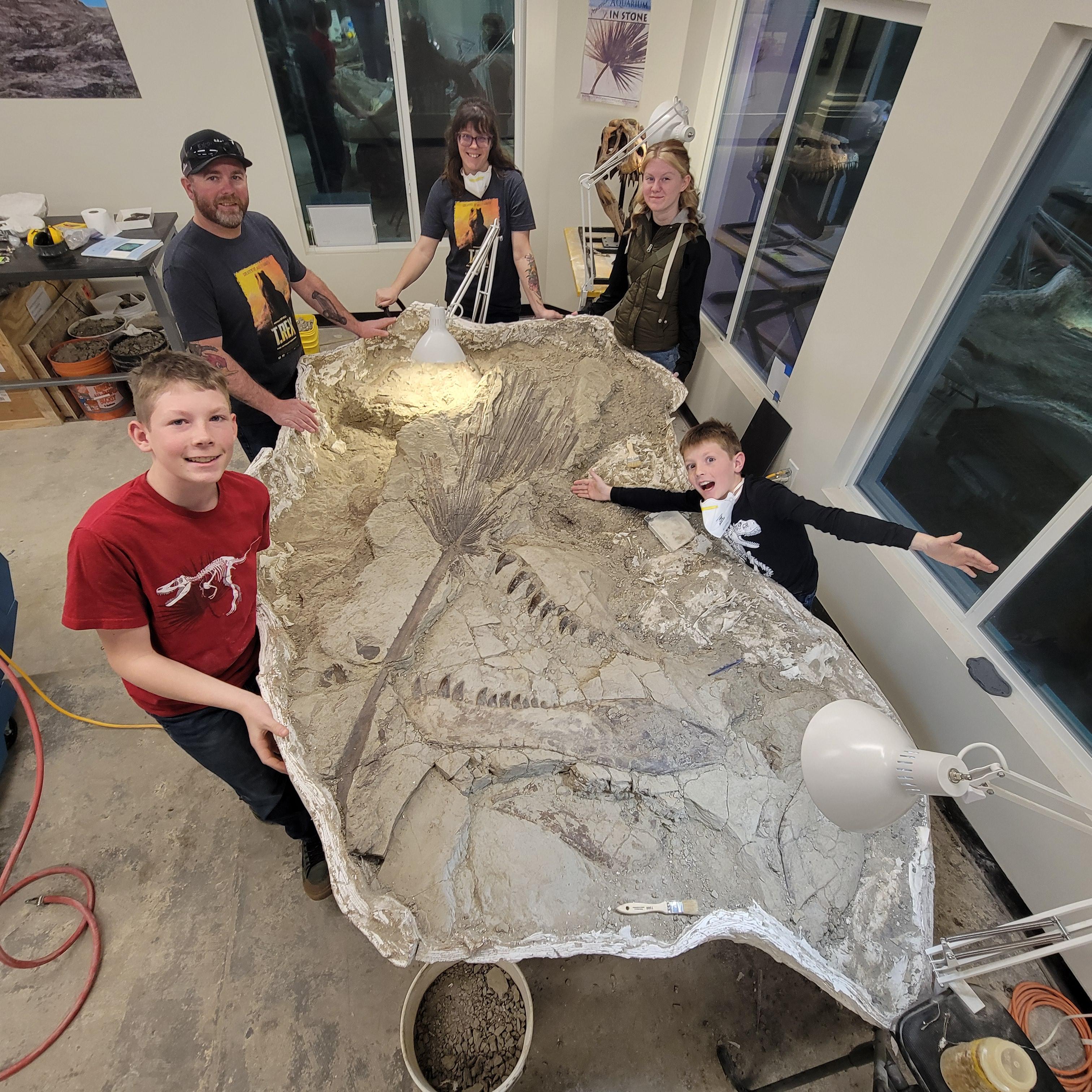
(Starting at the bottom left) Liam, Sam, Danielle, Emalynn and Jessin Fisher posing with Teen Rex (Photo: Alex Polich)
During the summer of 2024, another incredible discovery was made. Casey Thater, an Earth Sciences collections intern, was prospecting for new fossil localities on Dakota Prairie Grasslands managed by the US Forest Service when he found what appeared to be an ancient turtle shell poking out of the ground. Upon further excavation with Tyler Lyson, DMNS senior curator of vertebrate paleontology, they uncovered a partial frill, left postorbital (brow) horn and beak of an amazing Triceratops.
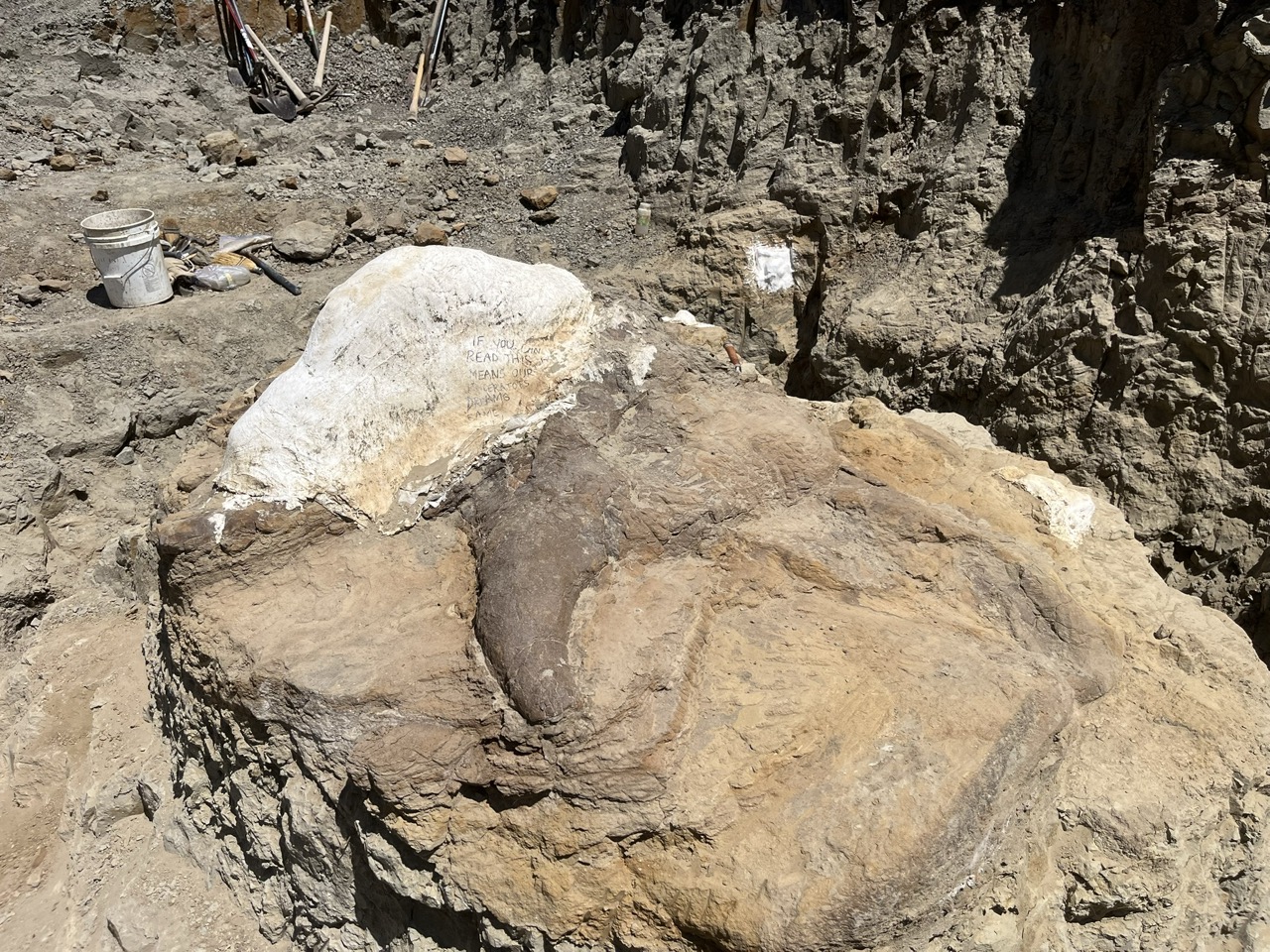
Triceratops Skull, Marmarth, North Dakota (Photo: Salvador Bastien)
The exposed sections of the skull–later nicknamed Triceratops Dreams–painted a picture of a rare, complete skull lying just below the surface. However, with this discovery occurring in the last weeks of our field season, and the sheer size of the skull requiring an excavation permit, there was no possibility for an excavation in 2024. The skull was reburied under a tarp to protect it against the harsh North Dakota weather until we could return the next summer.
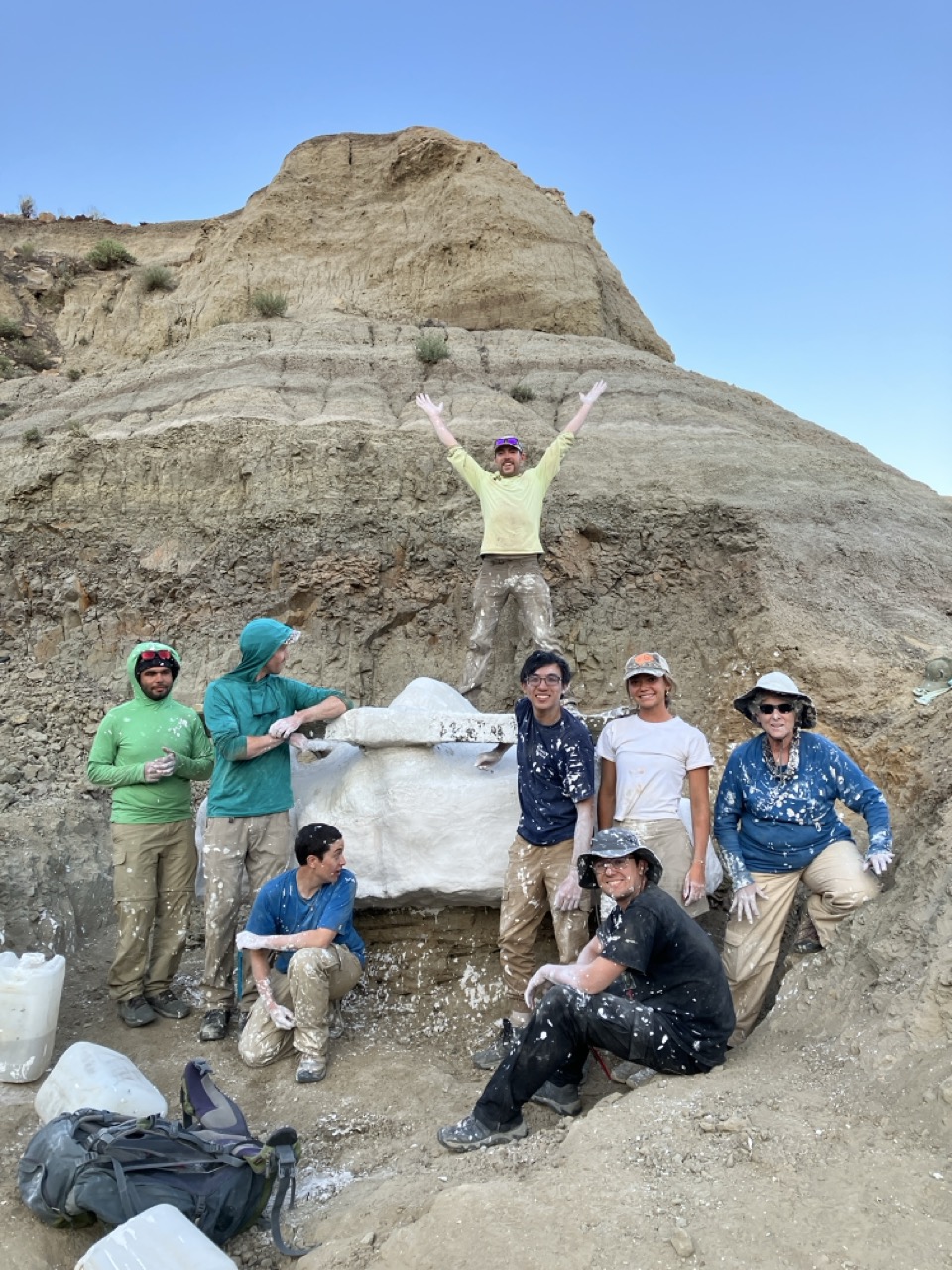
DMNS staff, interns and volunteers with jacket, Marmarth, North Dakota (Photo: Natalie Toth)
As soon as the 2025 field season began, a dedicated crew of staff, interns and volunteers worked tirelessly at the Triceratops quarry, swinging pickaxes, operating a 70lbs jackhammer called “The Brute” and shoveling thousands of pounds of dirt down the hill. After four weeks of back-breaking labor under the unforgiving North Dakota sun, our team excavated an impressive 5.4-ton field jacket–the second heaviest jacket collected in the Museum’s history!
The first of many surprises unearthed was a thrilling sight–the complete right lower jaw of the Triceratops still articulated with the predentary (Triceratops’ lower beak)! This articulation is rarely preserved during fossilization, making this a valuable addition to the fossil record. The original, and visible, three cervical vertebrae (neck bones) turned into a stunning 14-piece articulated vertebral series starting at the syncervical–a skeletal structure created by the fusion of the first three cervical vertebrae–and ending at the seventh dorsal (back) vertebra. It looks like a brown, prehistoric popcorn garland!
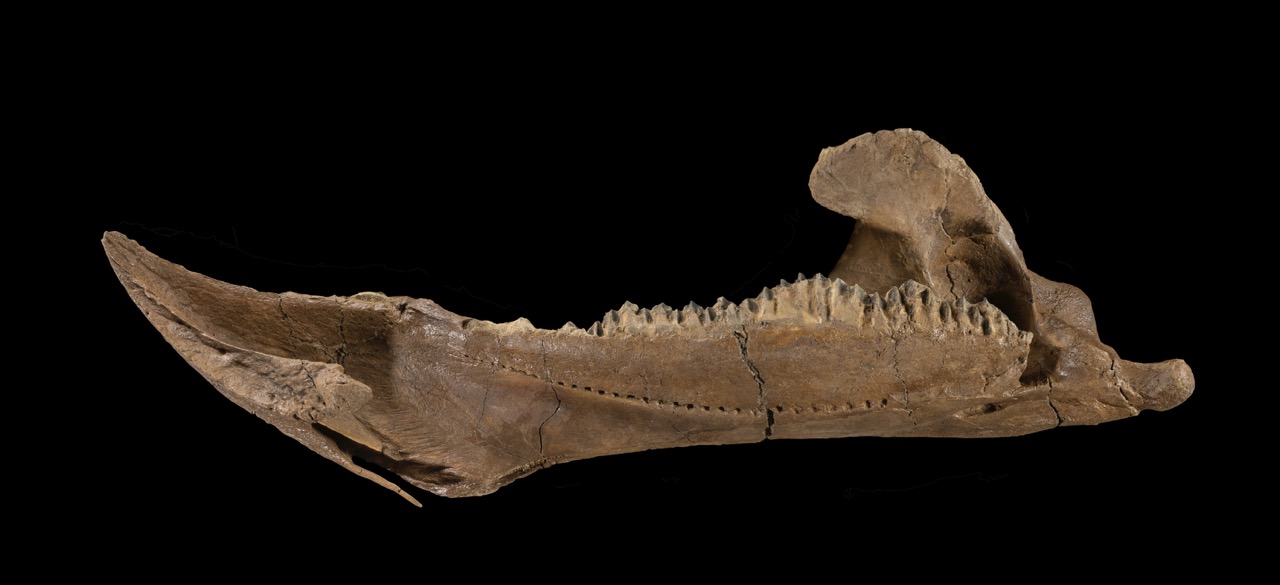
Triceratops Dreams right lower jaw. Denver Museum of Nature & Science. (Photo/ Rick Wicker)
Further preparation has yielded five dorsal ribs, four cervical ribs, the Triceratops’ left lower jaw, over 70 Triceratops teeth, three T. rex teeth and an unusually short right postorbital (brow) horn. This stubby horn is of interest as it makes the left postorbital horn nearly complete and more than triple in length, leaving us to hypothesize over what might have caused this abnormality – an injury sustained while alive or a postmortem break in an otherwise pristine fossil. As preparation continues, we are looking for signs of bone growth that could indicate either healing after an injury or an illness.
What’s next?
There is still plenty of work to be done. Over the coming months we will remove the articulated vertebral series, hundreds more pounds of matrix and Dreams’ six-foot long skull. When we left at the field at the end of the 2025 field season, there was one rib in the back wall of the quarry, just enough to make us dream of what else lies within the butte. We hope to return to the quarry for the 2026 field season to continue searching for the rest of the skeleton.
Spring 2026
In This Edition
-
Is That Fossil Real?
How We Forge Faux Fossils in Earth Sciences
-
A 1938 Time Capsule: Jarre Canyon Diorama
-
A New Approach to Deinstalling a Legacy Exhibition
-
When Triceratops Dreams Come True
-
Our Gems & Minerals Hall Will Be Completely Renovated, Expanded by 50%
The Dea Family Gems & Minerals Hall: Unveiling Late 2027
-
2026 Symposium Tackles the Role of Politics & Policy in Science
-
Guest Curators Enrich Indigenous Textile Installations
Share this: