
CATALYST
DENVER MUSEUM OF NATURE & SCIENCE ONLINE MAGAZINE
Is That Fossil Real?
How We Forge Faux Fossils in Earth Sciences
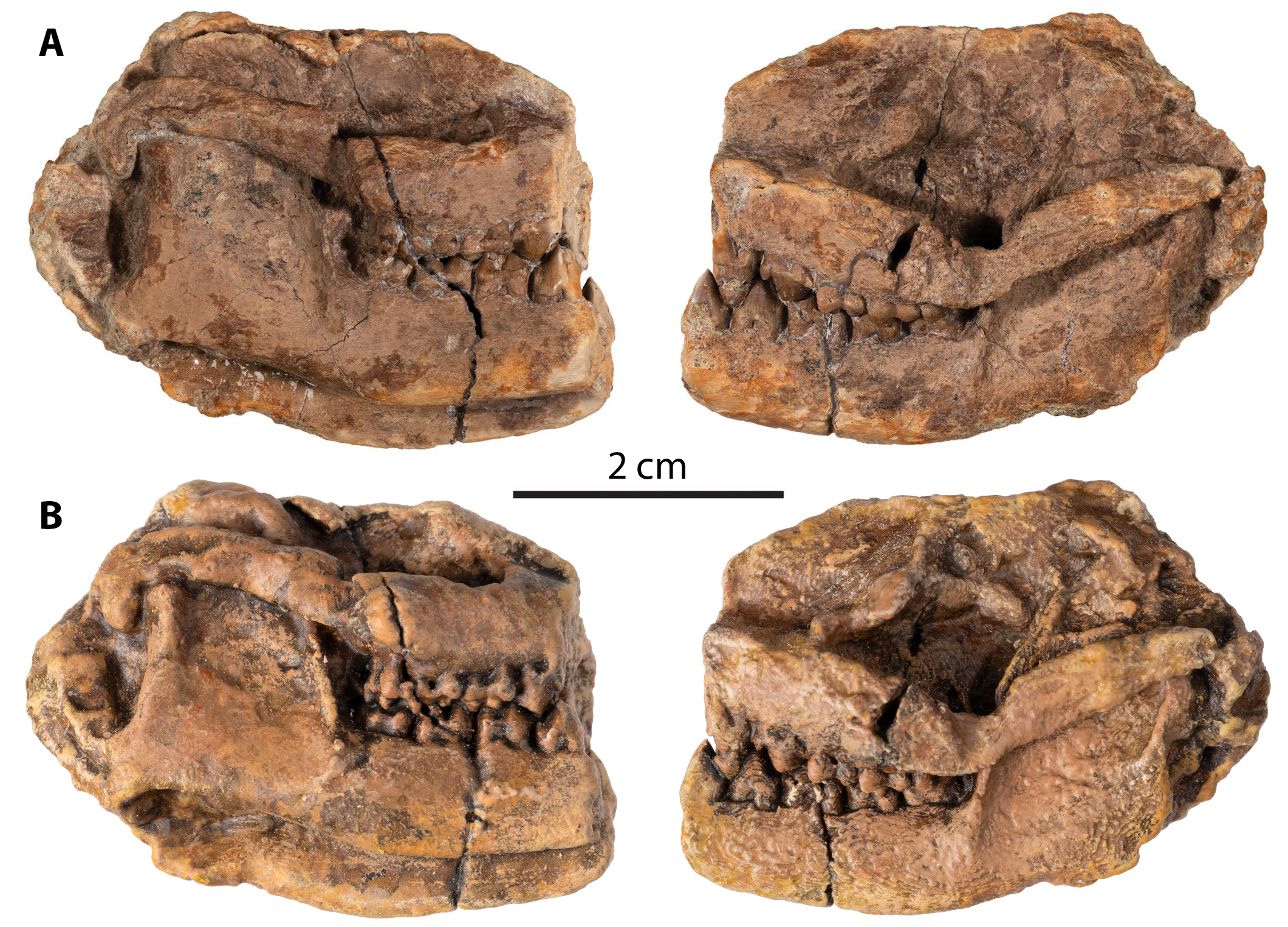
Militocodon lydae skull from the early Paleocene of the Denver Basin; A) Fossil; B) Replica on display in Japan. (Photo/Rick Wicker)
Through Technology and Craft, Our Team Produces Incredibly Realistic Fossil Replicas for Education and Research.
The vertebrate paleontology collection at the Denver Museum of Nature & Science houses thousands of scientifically significant and beautiful fossils. From far off countries like Madagascar, to localities close to home like Corral Bluffs in Colorado Springs, our collections span the globe. Yet our exhibitions, while rich in real and replica fossils, capture only a small fraction of the wonders stored at the Museum compared to the items in our underground Avenir Collection Center.
In the Earth Sciences department, we believe increasing public access to these fossils is essential to fostering curiosity about the natural world. There are, however, many potential consequences of exposing these rare natural resources to large audiences. As we prepared material to send to Japan for a traveling exhibition, “The Big 5 Mass Extinctions,” about Earth’s five major mass extinctions, we had to take some of those potential consequences into consideration. Some fossils are too delicate, or too significant to risk damaging them by shipping them halfway around the globe, and the absence of other fossils would delay active research at the Denver Museum of Nature & Science.
Read more: Museum Fossils and Science Tour in Japan
How can we balance our desire to share specimens that detail some of the most fascinating and dramatic points in Earth’s natural history while limiting potential damage to these one-of-a-kind fossils? The solution is to make our own fossils – exact replicas of the ones we keep in collections.
We use several methods of making fossil replicas, from time-tested silicone molding and resin casting to newer, higher-tech digital 3D imaging methods. These include computed tomography (CT) scanning, like what you’d get at the doctor, and structured light scanning, sometimes referred to as laser scanning.
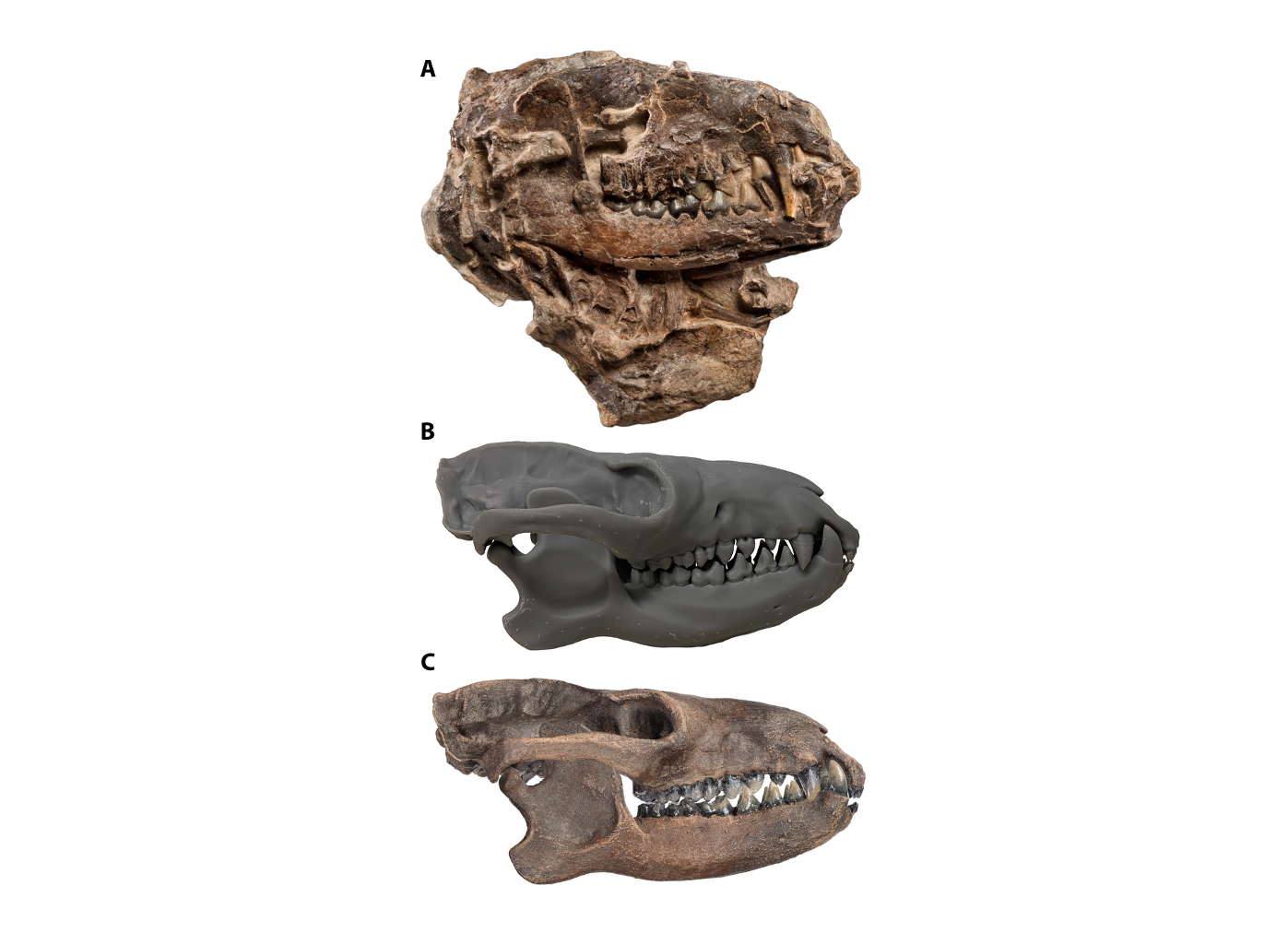
Skull of Loxolophus, an early Paleocene mammal from the Denver Basin; A) Fossil; B) Reconstructed 3D printed model; C) Painted model that is on display in the Big Five traveling exhibit in Japan (Photo: Rick Wicker and Sadie Sherman)
CT scans yield the highest accuracy, detail, and can also show the internal structures of fossils. Structured light scans capture slightly less resolution, and no internal structures, but are significantly faster and more accessible than CT scans. They’re accurate enough to detect the miniscule difference in elevation between the fossil and its painted collection label. The raw scan data from CT or structured light scanners are then uploaded to 3D editing software where we refine and assemble the scans into a digital 3D model of the fossil. This has become the preferred method of fossil reproduction at the Museum due to its speed, accessibility and gentleness on the genuine fossils.
Check out these 3D digital models: DMNS Vertebrate Paleontology Collection
Once we have a model, we use animation software to sculpt the specimen into a more convenient shape for 3D printing. Usually that means adding a removable flat base and scaffold to the fossil model, but sometimes we piece a shattered fossil back together digitally without removing each and every fragment from the rock physically. If we wanted to, we could shrink, grow, stretch or twist the specimen wildly out of shape in the software, while the real one sits safely in its home in the collections. This flexibility is useful when digitally reconstructing fossils that have been deformed or broken after millions of years in the ground, allowing us to restore them to a more lifelike state.
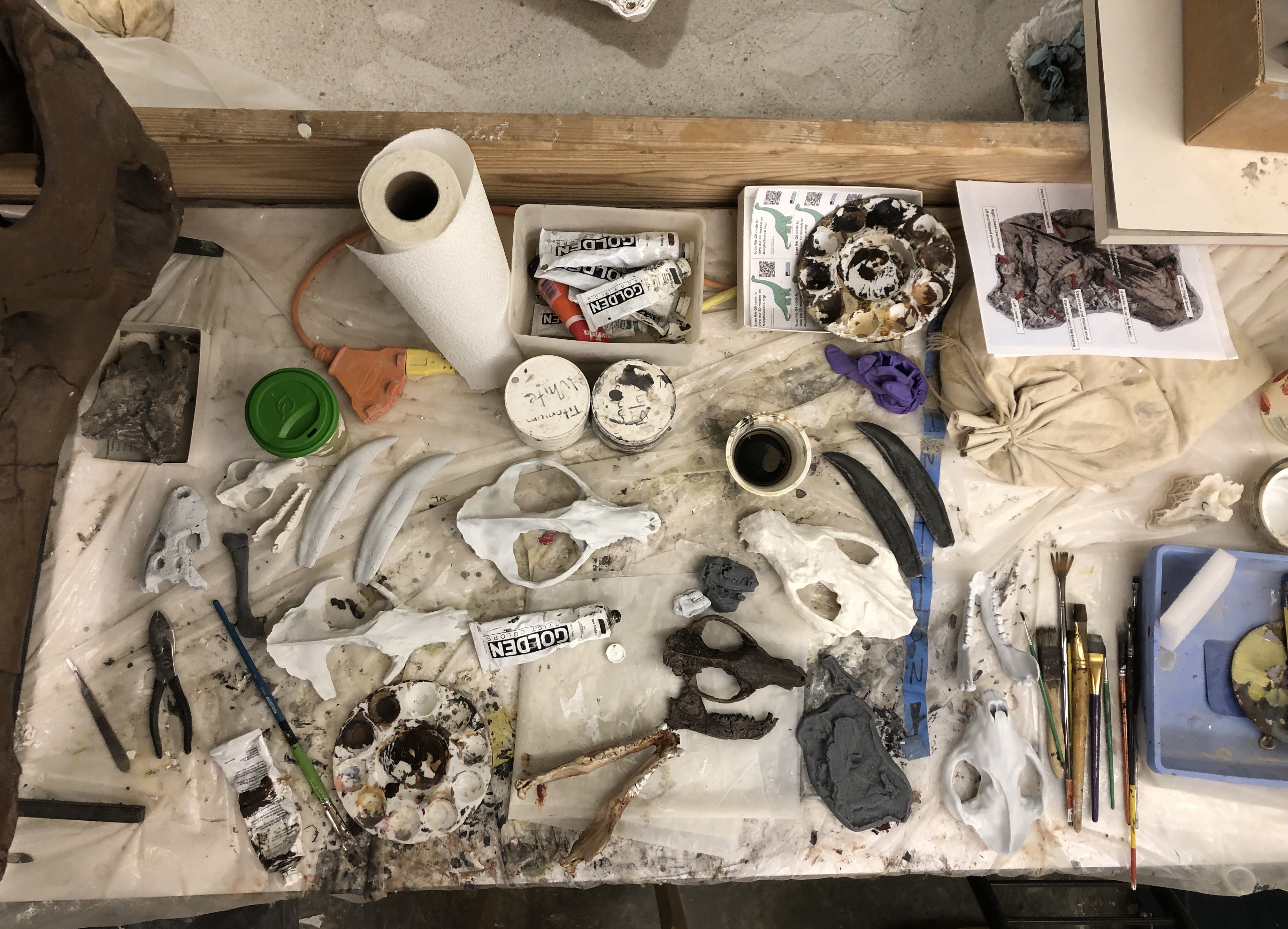
3D models of mammal skulls destined for Japan on the fossil preparation lab painting table. (Photo/Sadie Sherman)
After the 3D resin printer works its magic, we have a life-sized (or not!) plastic replica of the fossil, typically made of gray resin. If the 3D models are for research, this is the last step. However, replicas made for display or education are then coated with spray-on primer to prepare the model for paint. We like to use acrylic paints from our local craft supply store, picking up every shade of brown you can imagine! Like a rainbow, but brown.
To achieve realistic outcomes, we alternate between “washes” of watery paint and layers of dry brushing to emphasize the natural texture of the 3D models. This process can be time-consuming. Our team of interns, staff and volunteers use reference photos and spend hours on each replica to make it as realistic as possible. Once each 3D model is painted to satisfaction, they receive one final coat of clear protective spray to prevent chips in the paint. Teeth are sprayed with glossy clear coat and bone is sprayed with matte for a realistic, shiny toothed appearance.
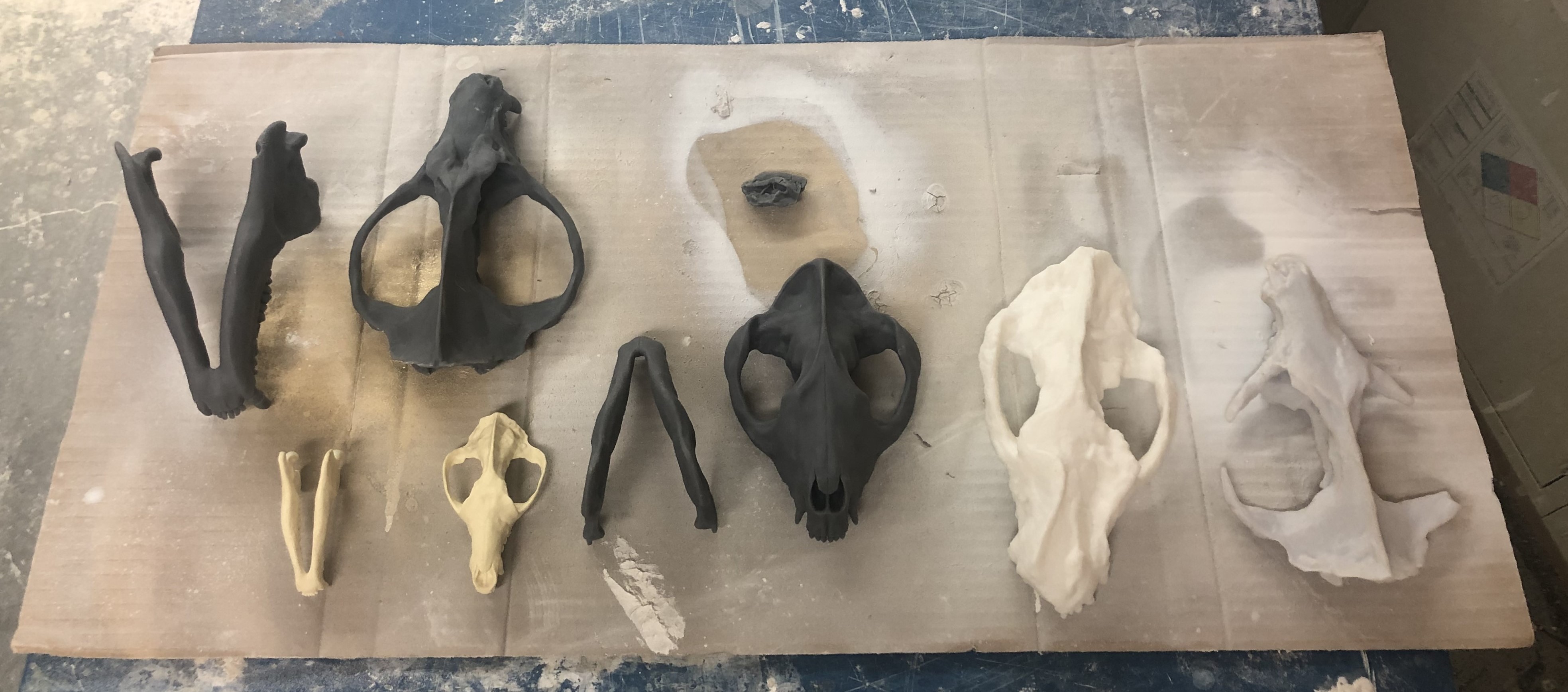
Unpainted 3D printed models of various Denver Basin mammal skulls. (Photo/Sadie Sherman)
This is the exact process that we used to create the replicas that we sent to Japan. After we finished the replicas, Earth Sciences collections manager Kristen Makenzie packaged them securely and put them on a plane to Tokyo, Japan.
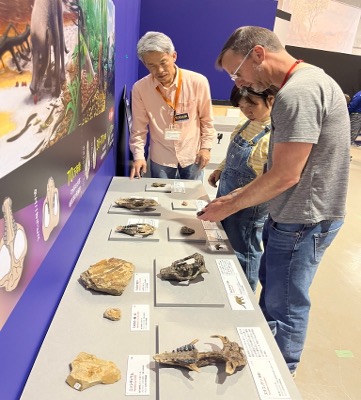
Painted fossil replicas on display in Japan. L to Right: Dr. Atsushi Yabe, Chisako Sakata, Dr. Tyler Lyson. (Photo/Salvador Bastien)
By creating replicas to send to Japan, we were able to share the story of Earth’s most dramatic moments with new audiences, while keeping our most delicate fossil specimens secure and available for ongoing research in the Avenir Collections Center here in Colorado. In this way, the fossils remain exactly where they belong — protected in collections — even as their stories travel the world.
Spring 2026
In This Edition
-
Is That Fossil Real?
How We Forge Faux Fossils in Earth Sciences
-
A 1938 Time Capsule: Jarre Canyon Diorama
-
A New Approach to Deinstalling a Legacy Exhibition
-
When Triceratops Dreams Come True
-
Our Gems & Minerals Hall Will Be Completely Renovated, Expanded by 50%
The Dea Family Gems & Minerals Hall: Unveiling Late 2027
-
2026 Symposium Tackles the Role of Politics & Policy in Science
-
Guest Curators Enrich Indigenous Textile Installations
Share this: